
Insight - IT Services & Consulting in Europe 2026

European IT services has moved from a discretionary budget item to a compliance obligation. NIS 2, DORA, and the EU AI Act have locked over 160,000 organizations into multi-year programs that cannot be cut when budgets tighten. Demand is no longer cyclical.
In 2025, only 13% of European companies have deployed AI at scale against near-universal cloud adoption, pointing to years of consulting work still ahead.
In M&A, acquirers are buying capabilities rather than market share. Talent is the constraint on supply. Firms with certified security operations, recurring public sector revenue, and IP-led delivery reach the upper end of a 5.7x to 10.5x DACH EV/EBITDA range. Headcount-heavy generalists face margin pressure even as revenues grow.
Key Takeaways:
The European IT services market is projected to reach $600bn by 2030, growing at 9.7% annually, well above the rate of the broader economy.
Regulatory mandates (NIS 2, DORA, EU AI Act) have permanently converted IT consulting from discretionary spend into a compliance obligation.
M&A has shifted from scale to scope: 60% of large transactions in 2025 targeted AI specialists and cybersecurity capabilities rather than market share.
DACH anchors European demand. Germany alone is on track for a market size of $130.5bn by 2031, constrained primarily by a talent gap of 149,000 unfilled IT roles.
IT services companies in DACH trade at 5.7x to 10.5x EV/EBITDA depending on size, with mid-cap assets commanding a 69% premium over micro-cap.
General Overview
The European IT services and consulting market is in re-acceleration. Following a slowdown in 2022 and 2023 as rising rates lengthened client decision cycles, demand returned sharply in 2024 and 2025. The catalyst was not a cyclical rebound. It was a regulatory and technological step-change that converted IT consulting from a discretionary investment into a compliance imperative.
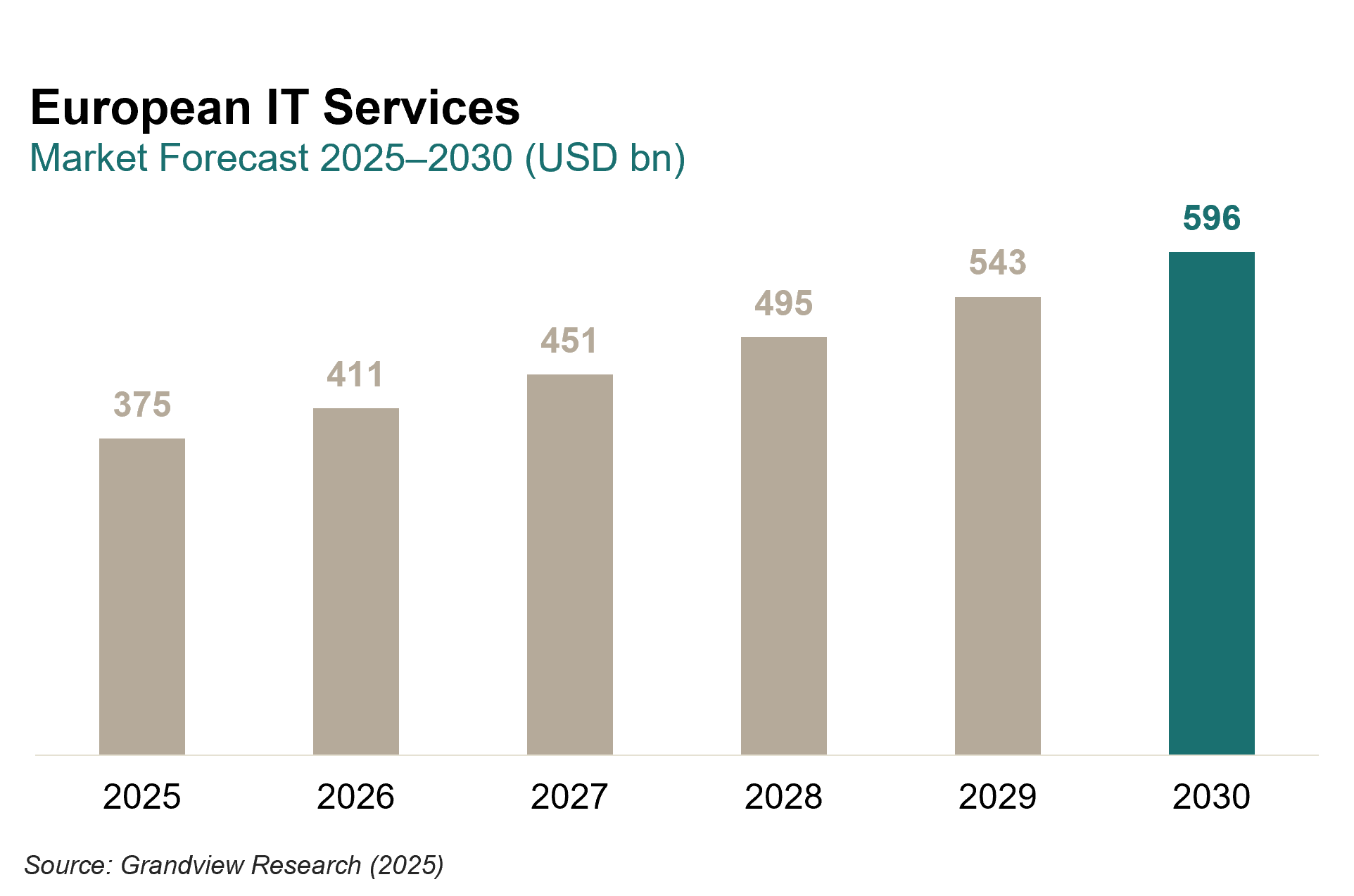
The market is projected to reach $600 billion by 2030, compounding at 9.7% annually. The average CAGR across public forecasts sits at 8.8%, well above the growth rate of the broader European economy, confirming that technology modernization has become a permanent board-level priority.
The market is also highly fragmented. Around 1.4 million enterprises operate across the EU information and communication services sector, employing 7.2 million people. Large enterprises, just 0.2% of the total count, generate 51% of net turnover. That concentration at the top, combined with a long tail of niche specialists, creates a clear rationale for buy-and-build M&A strategies.
The Shift: From Pilots to Production
Three regulatory instruments have reshaped the demand landscape and made a significant portion of IT consulting spend non-negotiable.
NIS 2, which came into force in January 2025, expanded the scope of regulated cybersecurity entities from 2,000 to over 160,000 organizations across the EU. Managed Security Services is now the sector's fastest-growing segment, projected to grow at 12.2% annually through 2031. DORA has locked financial institutions into multi-year compliance programs. BFSI remains the largest vertical at 19.9% of total consulting fees and will hold that position through the end of the decade. Germany's Digital Sovereignty mandates, including data residency rules for health and social data effective July 2024, require mission-critical workloads to remain within EU-controlled infrastructure, creating a durable advantage for European-domiciled providers.
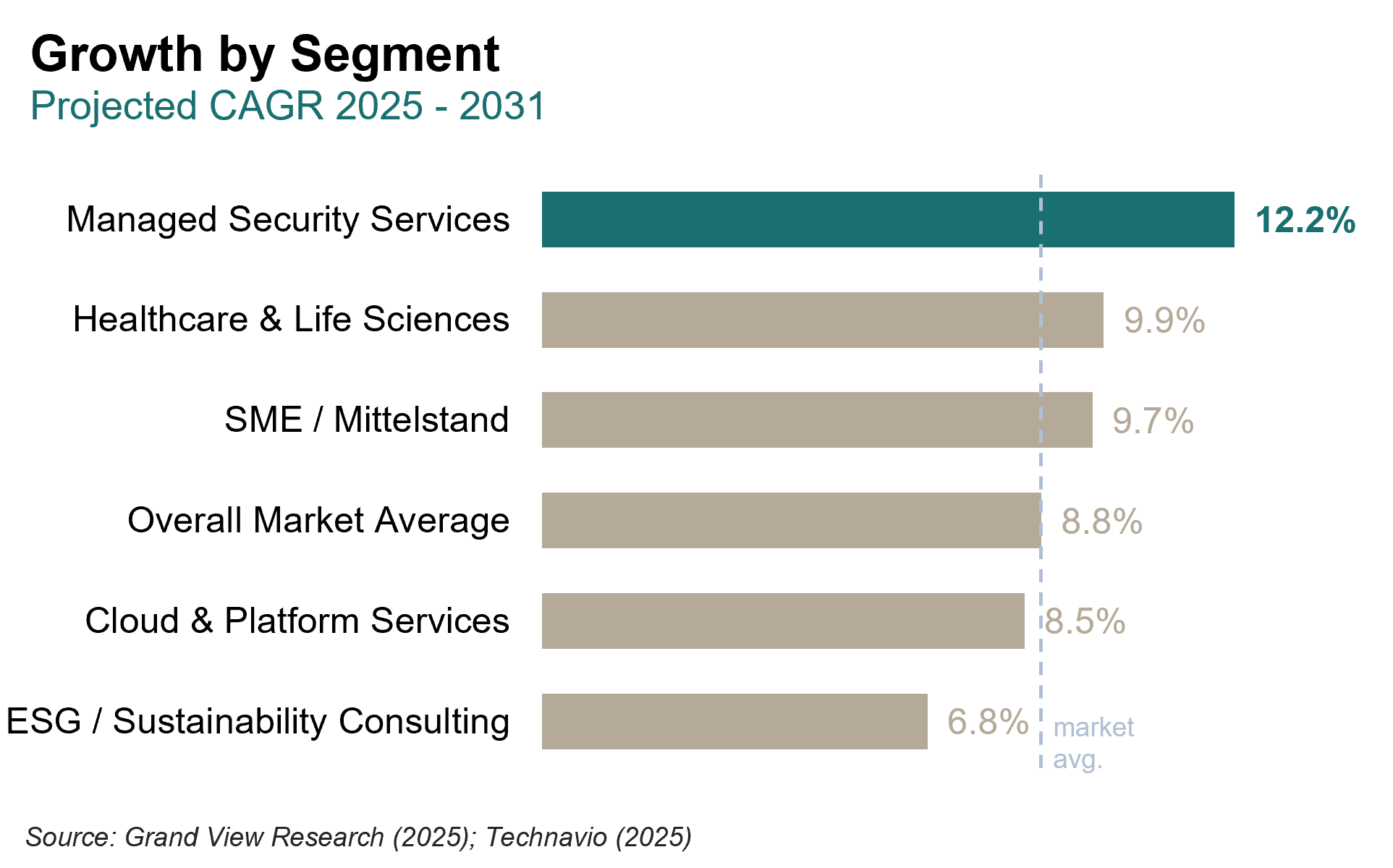
Alongside regulation, generative AI has matured from experimental to production. Only 13% of European companies were using AI at scale in 2025, against 97% cloud adoption. That gap represents years of implementation and governance consulting demand. Agentic AI systems, capable of executing business workflows autonomously, are the fastest-moving segment within the AI layer. Firms that productized AI tooling into their service delivery have seen EBITDA gains of up to 34%. Those that have not are facing simultaneous revenue growth and margin compression as procurement teams benchmark commoditized advisory against cheaper alternatives.
Competitive Landscape
The market splits between global generalists and regional specialists, with the dynamics between the two shifting quickly.
Global firms (Accenture, Capgemini, IBM, TCS) hold a combined European market share of 30 to 35%. They compete on scale, global delivery networks, and the capacity to manage multi-country transformation programs. Their disadvantage is regulatory exposure: German public sector mandates and data residency requirements frequently exclude providers that cannot demonstrate sovereign cloud capability.
DACH-focused specialists occupy a different position. Bechtle, with 140+ branch locations across Germany and Austria and 33% of revenue from long-term public sector contracts, operates a model global firms find difficult to replicate. T-Systems has built its differentiation around a sovereignty-first approach, acting as the primary EU interface for hyperscaler infrastructure. Valantic and Reply are outperforming the broader market in Data and AI, growing at 13.2% in 2024. The common thread across these specialists is local trust: compliance certifications, government relationships, and technician proximity that provide 24-hour response times no offshore team can match.
AI-native boutiques are the third force. Emerging firms deploying autonomous agents deliver services faster and at lower cost than traditional staffing-heavy models. They are not yet dominant in the mid-market, but they are compressing day rates in commoditized advisory, down 15 to 25% since 2023, and forcing incumbents to productize their IP or face permanent margin erosion.
DACH in Focus
Germany is the market's anchor and its most demanding operating environment simultaneously. The German IT services market is projected to reach $130.5 billion by 2031. Federal digitalization subsidies covering up to 50% of qualifying IT costs have meaningfully expanded the addressable SME market. That cohort is now growing at 9.7% annually, outpacing enterprise. The SAP and ERP modernization cycle, driven by the 2027 support sunset, adds an independent near-term demand driver on top of regulatory compliance.
The labor constraint is acute. Germany had 149,000 unfilled IT vacancies in 2023, a figure expected to quadruple by 2040. Time-to-fill for senior security roles runs nearly eight months. For acquirers and platform builders, talent is both the primary asset and the primary constraint.
Austria presents a similar dynamic at smaller scale. National sustainability targets and EU-aligned building regulations are driving adoption across the public and private sectors. Switzerland operates in a premium segment: senior consultant day rates regularly exceed CHF 2,400, reflecting demand concentration in regulated financial services and a persistent supply deficit.
M&A Dynamics
M&A activity in European IT services recovered sharply in 2025. Technology deal value globally rose 77% year on year, with Germany recording a 45% increase in aggregate deal value in the first nine months of the year. The strategic rationale has changed fundamentally from the prior cycle.
Scale deals, acquisitions primarily targeting market share and cost synergies, have ceded ground to scope deals. In 2025, 60% of large transactions above $1 billion were scope-driven: acquirers buying AI specialists, cybersecurity boutiques, or sovereign cloud capabilities they could not build organically fast enough. Nearly half of strategic technology deal value for transactions exceeding $500 million involved an AI-native target or a specific AI capability rationale.
Private equity is the most active buyer type, participating in over 70% of IT services transactions in key European markets. Platform roll-ups in managed services are the dominant acquisition thesis: building recurring revenue density around an anchor asset, then adding capabilities and geographic reach. The KKR and Datagroup transaction is the clearest DACH example of the playbook.
Due diligence has also changed materially. One in five acquirers in 2025 walked away from a technology transaction citing EU AI Act compliance risk. Data residency gaps and undisclosed sovereignty exposures are now material deal risks, not footnotes. Regulatory audits have become as critical as financial due diligence.
Valuation Context
IT services companies in DACH trade at a meaningful size premium. Micro-cap assets (below €5m EBITDA) currently transact at 5.7x to 6.8x EV/EBITDA. Small-cap companies (€5-50m) command 6.8x to 8.5x. Mid-cap assets above €50m EBITDA are being acquired at 8.1x to 10.5x, according to DUB / DEALCIRCLE KMU Multiples for Q2 2026. That is a 69% ceiling premium from the smallest to the largest size class, more pronounced than in most other DACH sectors.
Software and Digital Platforms consistently trade at a slight premium to pure-play IT services, reaching 10.9x at the mid-cap level. The gap reflects the higher recurring revenue predictability and IP content of software businesses relative to services. For acquirers building a platform, this implies that bolt-on service companies offer better entry multiples than software targets, while the reverse applies if the strategic priority is building a recurring-revenue base.
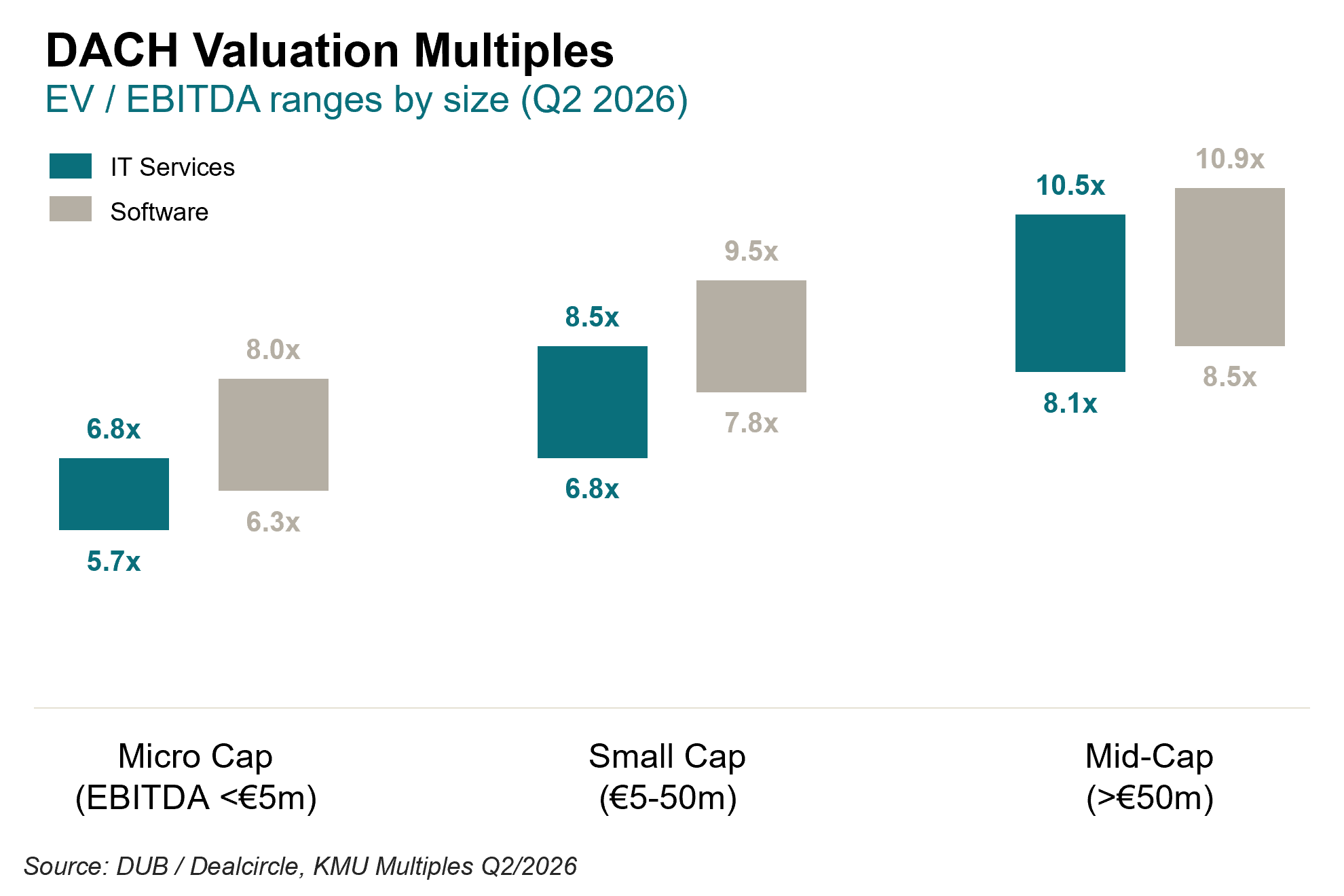
Multiples have normalized from the 2021 and 2022 peaks, when compressed interest rates inflated software multiples across the board. The current range reflects a more balanced environment: strong underlying demand, tighter financing conditions, and growing due diligence scrutiny around regulatory compliance. Businesses with certified security operations centers, sovereign cloud capability, and government contract revenue are consistently transacting at the upper end of their size-class range.
Outlook
The base case for European IT services through 2030 is growth at approximately 8.8% per year. The primary driver is regulatory obligation. NIS 2, DORA, CSRD, and the EU AI Act will generate multi-year consulting programs regardless of macroeconomic conditions. Unlike cyclical demand tied to investment budgets, compliance spending cannot be deferred once a deadline has passed.
The constraint is on the delivery side, not the demand side. A 2.7 million ICT vacancy gap across the EU-27 is the binding limit on how fast the industry can scale. Firms that move from labor-intensive delivery to IP-led, AI-augmented models will expand margins as the market grows. Those that remain dependent on headcount will face simultaneous revenue growth and cost pressure.
For strategic acquirers and financial sponsors, the target profile is increasingly specific. Firms with sovereign cloud certification, recurring public sector revenue, and proprietary AI tooling are well-positioned and priced accordingly. The mid-market in DACH remains the most active segment, with fragmentation and a succession wave among owner-managed IT services firms continuing to produce deal supply across all size classes. Buyers who move early, before regulatory compliance requirements have been fully priced into seller expectations, will capture the best risk-adjusted entry points.
Frequently Asked Questions
-
The European IT services and consulting market is projected to reach $600 billion by 2030, growing at a CAGR of 9.7%. The market is estimated at approximately $375 billion in 2025. Germany accounts for roughly 25% of total European IT services revenue, with its national market projected at $130.5 billion by 2031. (Source: Grand View Research, 2025)
-
Three regulatory mandates are the primary growth drivers: NIS 2 (which expanded regulated cybersecurity entities from 2,000 to over 160,000 organizations in January 2025), DORA (locking financial institutions into multi-year compliance programs), and Digital Sovereignty mandates requiring EU-based data residency for regulated sectors. These have converted a large share of IT consulting spend from discretionary to non-discretionary. The transition of AI from experimental pilots to production-scale deployment is a secondary growth driver.
-
NIS 2, effective January 2025, expanded mandatory cybersecurity compliance to over 160,000 organizations across the EU. This has made Managed Security Services the sector's fastest-growing segment at a projected 12.2% CAGR through 2031. DORA has made digital operational resilience a legal requirement for financial institutions, locking them into multi-year IT modernization and compliance programs. Together these two directives have made cybersecurity and resilience consulting largely non-discretionary.
-
According to DUB / DEALCIRCLE KMU Multiples for Q2 2026, IT services companies in DACH trade between 5.7x and 6.8x EV/EBITDA for micro-cap businesses (below €5m EBITDA), 6.8x to 8.5x for small-cap (€5-50m EBITDA), and 8.1x to 10.5x for mid-cap (above €50m EBITDA). Software and digital platforms command a slight premium, reaching up to 10.9x for mid-cap assets.
-
The EU-27 had approximately 2.7 million unfilled ICT vacancies in 2024. Germany alone had 149,000 open IT positions in 2023, a figure expected to quadruple by 2040. Time-to-fill for senior security roles in Germany runs nearly eight months. For acquirers, firms with established talent pipelines, certified security operations centers, and IP-led delivery models that reduce headcount dependency carry a meaningful multiple premium over staffing-heavy peers.
-
M&A in European IT services is being driven by three converging factors: the need to acquire AI and cybersecurity capabilities quickly (60% of large 2025 transactions were scope-driven rather than scale-driven), private equity consolidation of managed services platforms (PE participated in over 70% of IT services deals in key European markets), and regulatory compliance programs creating recurring, visible revenue streams that make IT services assets more attractive to financial sponsors.
-
Less so than most professional services sectors. IT spending is increasingly treated as essential infrastructure rather than a discretionary cost. The sector slowed in 2022 and 2023 as rising rates lengthened decision cycles, but it did not contract. Public sector contracts and regulatory compliance programs provide a countercyclical buffer. Firms with more than 50% of revenue from managed services or government contracts are particularly resilient to economic downturns.
-
Eagle Scope – European IT Consulting Industry Analysis (StrategyBridgeAI / Adquin, 2025); Grand View Research, Europe IT Services Market (2024-25); Bain & Company, Global M&A Report 2026; Dealsuite Trends Report 2026; DUB / DEALCIRCLE, KMU Multiples Q2/2026; Bechtle AG Annual Report 2024; TechNavio, IT Professional Services Market (2024-26); Eurostat, Information & Communication Services Sector Profile (2024-25); Slaughter and May, Tech M&A in 2025; CompTIA, IT Industry Outlook 2025.
To stay connected and receive our latest insights and news, please subscribe.